Showing posts with label Free and low-cost LMHC CEUs. Show all posts

Tuesday, October 22, 2024

NCTSN has a number of free NBCC/LMHC CEUs

It requires creation of an account to see very much, but there are dozens of self-study free CEUs at their website here. Reminder that for Massachusetts LMHCs, we can obtain up to half (15) of our CEUs via asynchronous methods; at least 15 are required to be live online or live in-person trainings.

EDIT 11/01/24: I did one on working with young children in the foster care system. It was pretty awful -- completely lacking in any competence regarding the biases of the system, provided a case example with absolutely no mention of culture, referred to parents of a reunifying child as "birth parents," and was clearly not remotely informed by formerly adopted or fostered adults. It was also based on a model in which a local CPS agency had contracted with an agency to provide highly qualified clinicians for all of a family's visitation and extensive therapeutic work with child/family and foster providers. Which, great, but not applicable to nearly all families involved in the system who don't have such a thing available. I'm going to try one of the trainings that isn't CPS-specific and see if it is any better. 

Disclaimer: My only affiliation with this organization is having served on a regional advisory board of theirs in the past that had nothing to do with CEUs. I post free/low-cost LMHC CEUs when I come across them, as one of many efforts to decolonize mental health practice.

Thursday, September 5, 2024

More free Zoom LMHC CEUs

I was actually looking for free yoga classes, and found that there are hundreds of them on eventbrite (set location to "online," set price to only free offerings). My family and I have done a few classes and have found them to be pretty solid. Many of the classes are one-time offerings from healthcare organizations and community centers. Some are organizations that look a bit culty, but I'm able to look past that for a free class where I can log right off at the end and don't have to engage in small talk.

One of the yoga classes I found was for professionals, and mentioned CEUs. I assumed that they would be CEUs for one of the professions that doesn't require formal approval, but was surprised to see that the organization offers NAADAC CEUs, which is an NBCC-approved provider. The organization is Aliya Academy, and they have a number of different free trainings offering 1 CEU each. Most of them are focused on those who have substance use disorders, as this is the organization's mission. 

If you've read my blog before, you know my feeling about CEUs: There is nothing in place to assess whether clinicians are actually engaging in relevant learning and applying it to our work. CEU credits do not accomplish this goal. Those of us who are committed to practicing ethically and effectively are constantly engaged in learning through keeping up on research and listening to experiences of marginalized people, and our participation in formal CEU courses is pretty immaterial. CEUs are just a formality we must go through, most of the available courses are massively overpriced yet contain outdated and disturbingly biased content, so we might as well go with free CEUs of potentially questionable quality. I personally get my actual continuing education by reading and watching content from autistic and other disabled folks, former foster youth, systems-involved parents, people affected by carceral systems, and so forth. I get my CEU credits by attending Zoom workshops that explain what ADHD or depression is –– usually badly, with a white-middle class bias, and with no content from folks with the conditions –– and wonder how there are licensed clinicians who do not already know this material.

William James College is also hosting a free Zoom CEU workshop on stalking behavior in autistic folks. It doesn't appear to have any content from actual autistic folks, so I'm skeptical, but it's free. It's worth signing up for their CEU e-mails, as they frequently have free ones. A few have actually been quite good and have been largely based on lived experience, while others have been typically poor-quality CEUs of things that people should already know. 

[Usual disclaimer that I am not affiliated with these organizations. I have no experience with Aliya Academy and minimal experience with WJC. I am not specifically endorsing the trainings. I post free and low-cost CEUs I encounter for the reasons stated above.]

Tuesday, October 10, 2023

Free online DC 0-5 training with 16 MA LMHC/LICSW/NBCC/NASW CEUs

For Massachusetts providers only. Get half of your biannual CEU requirement completed for free. It's this October, which is unfortunate for those of us who already have 2022-2023 completed, but fortunate for those who have waited until the last minute. (Or social workers; I think y'all renew in even years?)

I've taken the training in the past and it's actually quite good. I definitely encourage people to sign up if you can, especially if just to let folks know there is demand for online/accessible options for these types of trainings. 

Information here.

[Usual disclaimer that I have no affiliation with this training or organization and just am passing along free/low-cost CEUs.]

Monday, April 10, 2023

Join me on April 18 for a training for feeding professionals on supporting families affected by the child welfare system

EDIT: The recording of the training is now available for free and will be indefinitely. 


I will be presenting a live webinar hosted by esteemed feeding expert Katja Rowell. CEUs are available for OTs and SLPs, and other disciplines can likely submit the training for one-time approval. We will be discussing how this is a system that has been demonstrated to err in both directions as well as dispelling several myths providers typically believe regarding this system.
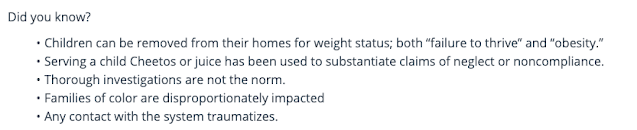

I have worked with Dr. Rowell on some other projects related to the child welfare system, such as this guide on the NACAC website in which we dispelled an often-repeated myth in child welfare regarding food preoccupation in addition to giving other tips on trauma-informed feeding practices. Clinicians and foster parents are typically taught to view food issues in children as a sign of having not received consistent food or care in previous homes. While this can be one cause, if we set aside biases we are taught regarding families involved in the system, it should be obvious to clinicians with a solid understanding of attachment that experiencing a sudden change in caregivers (such as being removed from home...) will often also cause children to behave in ways indicating they question whether their needs will be met consistently. Children who act unsure if there will be enough food have not necessarily experienced a shortage of food, but probably have had some sort of caregiving or security abruptly lost – or may have sensory differences, short-term memory difficulties, or other issues that may or may not be related to attachment or loss.

While our upcoming training is geared toward those who encounter children with feeding or eating concerns in their work, it points to a bigger approach I am looking to take these days: rather than continuing to present to communities already engaged in changing/improving/abolishing the child welfare system, who tend to be quite aware of the harms done, I am taking my writing and training to other provider communities that interface with this system but don't have much of an understanding of what goes on in it. My aim is to educate and guide providers to practice in a way in which we fulfill our legal and professional obligations while prevented demonstrated harm done by overreporting and/or carelessness in documenting and sharing information. 

As I will discuss in more depth during the training, I have come to believe that much of the unnecessary child welfare involvement and overreporting results from providers who erroneously assume that 1) the system affords families due process and that 2) investigations involve evaluation by experts in the matter at hand. 

For instance, when I complete clinical child/family evaluations for attorneys through the public defender's office, I typically interview the person who made the initial abuse/neglect report, among other relevant parties. I might have a situation such as a toddler who was removed from home due to a broken arm, and I will ask the provider who made the report to tell me why they believe there was abuse or neglect. They often respond by telling me they don't have any reason to believe this, but they generally report certain injuries in young children so that the CPS agency can determine what happened. When I ask further questions regarding what would need to be done to appropriately determine this, it becomes clear that the provider assumes CPS investigators enlist radiologists with forensic expertise and folks such as accident reconstruction experts – the same sort of things I assumed before I began working closely with this type of case and learned that the decisions are made solely by CPS investigators with a bachelor's or sometimes a master's degree and no specialized training. Providers working in an ongoing fashion with families involved in the system also speak to me using language indicating that they believe a judge determined the child to have been abused with a high degree of certainty – in reality, what happens is the CPS agency petitions the court to take custody of the child based on the CPS agency's determinations, the family is given no opportunity to respond, and the court typically enters the CPS agency's testimony as fact.

It is vitally important for providers to understand this dynamic: When we see children and families in our specific professional roles – in this case, as experts in pediatric feeding and eating concerns – those of us with independent professional licenses and the clinical and research experience that go along with it possess a much higher level of expertise in assessing feeding and eating dynamics than nearly anyone employed by a CPS agency. When we have concerns, our job is, well, to do our job. It is not to pass the buck to someone who does not possess sufficient skills to assess the situation and who has legitimate reasons to err on the side of harming families. The law requires us to report "reason to believe a child has been abused or neglected;" we should not be reporting "concerns" or "referrals for additional services." In order to prevent harm, we need to be employing our own expertise and consulting with and referring to other experts, and only reporting if our expert assessment has in fact revealed abuse or neglect. 

Please note that none of my trainings or writings are intended as criticism of individual workers, many of whom are trusted colleagues doing some pretty remarkable work in a very broken system. Rather, I am working to bring awareness to providers of a system which, by design, affords families considerably fewer rights than the criminal system – and which is frequently argued by experts to be blatantly unconstitutional in its current form. Without a thorough understanding of this system, most clinicians overreport abuse and neglect well beyond what is legally required, as well as defer to biased and perfunctory abuse/neglect determinations as fact. In order to uphold our ethical obligations to refrain from harming our clients, clinicians need to be informed about the workings of this system.

To register for the April 18 training, click here. Please e-mail me as well if you are interested in a similar training either in-person or virtually.

Friday, October 21, 2022

2 free CEUs for LMHC (NBCC), Psychologist, Nursing, Social Work, Educators

I just received an e-mail advertising this course, group therapy via telehealth at William James College. The course is completely free.

I will mention that I have taken it before, and honestly, it's kind of eh. But it is free. 

There was a lot of ableism, such as insistence that group therapists should always have the zoom chat turned off and ignoring of comments by a few of us that using chat is an accommodation for neurodivergent folks, as well as citing neurodivergent presentations as screen-out criteria for appropriateness for group therapy.*

Also, just, why would you not leave chat on? Why would you not want people to be able to type "be right back" if they need to use the restroom rather than interrupting? Why would you not want someone to be able to drop a helpful link in the chat if they're mentioning a resource? If for some reason you find people are saying off-topic or disruptive things in the chat, then you use your group leadership skills and remind people that we need to maintain one conversation at a time, and chat comments need to be on the same topic as the out loud conversation aside from quick "be right back"-type comments. 


*I will die on this hill: The "I don't work with the autistic 'population' though" talk from so many providers is incorrect and damaging. You do work with autistic people. If you work with people at all, about 2-5% of them are autistic. If you work in mental health or medical settings, you might be seeing 10-20% autistic folks, but if you are insisting you don't, you probably are relying on stereotypes of young white boys and don't actually recognize autism. Also, along those lines, some colleagues and I are working on a project about completely abandoning the idea of "populations" and recognizing that cultural competence is primarily a mindset, while at the same time we should all have basic familiarity with experiences that occur fairly frequently. 

Further reading: 

1 in 5 adults presenting to outpatient psychiatry are autistic

Autistic traits found in 20% of young adults seeking addiction treatment

I don't know of any studies on rates of autistic and other neurodivergent presentations in parents involved in the child welfare system, but anecdotally it's very very high, with no acknowledgement whatsoever that it's an area of needed cultural competence.


I have no affiliation with Williams James College other than minimally as someone who periodically supervises interns for them. I post free/low-cost CEUs I find in order to promote equity and representation in the field, and sometimes share my own personal thoughts about the trainings and/or the trainer. 

Monday, March 28, 2022

Another free CEU for Massachusetts LMHCs, psychologists, social workers, nurses, educators

Another free one from William James College, April 8 from noon-1pm, on suicide prevention.  

Offers one CEU for Massachusetts LMHC (or any state that accepts NBCC), psychologists, social workers, nurses, educators.

[Usual caveat that I have no affiliation with the training or WJC other than being a field training supervisor at times. I generally post any CEUs I encounter that are free or low-cost regardless of topic or quality, unless they appear seriously problematic, in which case I may post them anyway and encourage people to attend and engage in advocacy as appropriate. I also at times post trainings with trainers or organizations I do personally endorse, and will specify when this is the case.]

Monday, March 14, 2022

Free 2 CEU course for LMHC, SW, psychologists, nurses, educators

William James College is offering this free course on group therapy via telehealth. The list of pending and approved CEUs is here.

[Usual disclaimer that I have no affiliation with the presenter or organization other than having been a fieldwork supervisor for the college. I post pretty much any free/low-cost CEUs I find unless they seem highly problematic, and even then I sometimes post them and encourage people to attend and provide healthy pushback.]

Tuesday, April 27, 2021

William James College has more free CEUs

This looks pretty good, especially for child welfare/court folks:

Parenting and Substance Use Disorder: A Bi-Generational Approach
May 19, 2021, 9am - 10:30am
1.5 NBCC CEUs

Usual disclaimer: I am just passing this along. I have no particular affiliation with this training other than extremely minimal affiliation with the school.