Monday, July 6, 2026

Low-cost Zoom D&D groups for tweens and teens starting soon


Image: roleplaying dice and stones reading "magic" and "strength," lying on a six-color pride flag

  • Groups meet weekly on Zoom for 90 minutes.
  • Group is led by a clinician/educator along with a previously identified teen or young adult Dungeon Master. 
  • Groups are open to anyone, anywhere in the world, as they are not therapy groups. Insurance cannot be billed for these groups.
  • Any youth who identify as comfortable in LGBTQ space or wanting to explore LGBTQ space are welcome. Game play is LGBTQ affirming and youth tend to play as out queer characters. Youth will not typically be in the position of needing to discuss their personal identities except as they choose to. 
  • Our social environment is neurodiversity affirming, learners tend to be neurodivergent, and we aim to be open and responsive to any stated or apparent needs. Communicating through text chat, voice, or a combo are all great. Facilitator employs a model of universal social skills in which youth receive explanations of social skills such as asking for consent before offering advice, understanding the difference between fact and opinion, using coping skills to handle disappointment. 
  • Players should have basic familiarity with the game, such as watching others play or via YouTube. We are low-key and friendly and happy to help out players who don't have all of the rules of gameplay memorized. Beginners are very much welcome!
  • Group is $10 per week, charged weekly. Sliding scale is available for those with financial need.

Ages 8-12
10:30am-12:00pm Wednesdays Eastern U.S. time 
Five weeks

• August 19
• August 26
• September 2
• September 9
• September 16


Ages 13-17
5:00pm-6:30pm Mondays Eastern U.S. time 
Five weeks

• July 27
• August 3
• August 10
• August 17
• August 24


Ages 13-17
5:00pm-6:30pm Mondays Eastern U.S. time 
Five weeks

• September 7
• September 14
• September 28
• October 5
• October 12


E-mail erika@erikashira.com to register

Thursday, May 21, 2026

Some sections of LGBTQ youth groups currently have no waitlist


Alt: heavily edited photo of rainbow umbrellas and banners at a pride parade

weekly Zoom groups for LGBTQ youth 8-18 

open to folks located anywhere in the world
$10 per week 
sliding scale available
not insurance eligible/not a therapeutic group
erika @ erikashira . com if interested

This is not a therapy group, so it is open to folks located anywhere. Members tend to be from the U.S. and Canada, though we have had folks from dozens of countries. No records are kept, and members register using just a first name (does not have to be legal name). 

Group members tend to be mostly neurodivergent, a mix of about 2/3 homeschoolers and 1/3 not. We mostly free chat about whatever the group wants, whether that's queer topics, personal updates, hobbies, current events, or really anything else. As these are not therapy groups, members and facilitator can provide general support and suggestions for dealing with queer-related exploration, learning issues, mental health issues, and so forth, but I cannot provide tailored medical advice as I might in a therapy group. Members often bring photos/videos/etc. to share as well, whether their own creations or just things they enjoyed and thought others might like. When people are interested, we sometimes play games (always free-to-play online games that do not require any particular hardware or software, like Garticphone or Jackbox). 

We are completely flexible regarding participation with camera/mic on or off, chat box only, or switching it up depending on comfort level. For safety, I do need members to initially verify on camera that they are the same person each time and appear to be roughly in the correct age range. As members tend to be neurodivergent, I try to provide predictability and clear feedback. Particularly if we are playing a game or doing an activity, I let people know clearly for instance whether I expect hand-raising. During interactions, I promote universal social skills -- boundaries, consent, perspective-taking, inclusion, clear communication, self-advocacy, manners, etc. -- but I do not believe in promoting neurotypical communication styles or white/Anglo communication styles over other equally valid communication styles. Youth and parents are very much welcome to let me know if youth have particular types of accommodations or preferred feedback styles that are helpful. 

Current groups:

Wednesday 12pm Eastern U.S. time ages 8-12
Wednesday 1pm Eastern U.S. time ages 13-18
Wednesday 5pm Eastern U.S. time ages 13-18WAITLIST
Wednesday 6pm Eastern U.S. time ages 13-18WAITLIST
Wednesday 8pm Eastern U.S. time ages 13-18

Thursday 6pm Eastern U.S. time ages 13-18
Thursday 7pm Eastern U.S. time ages 8-12WAITLIST

Sunday 4pm Eastern U.S. time ages 13-18WAITLIST
Sunday 5pm Eastern U.S. time ages 8-12WAITLIST

Folks are also welcome to join the waitlist for any other slots. erika @ erikashira . com

We also run LGBTQ Dungeons and Dragons campaigns and LGBTQ book groups with a similar flavor, but with a specific focus -- e-mail for more info. 

Thursday, March 5, 2026

Cortica ABA therapy program is using robots to ignore people's boundaries

So first, Niloufar Far of Cortica sent me three unsolicited e-mails within two weeks, including one containing the line, "I hope you take my persistence as a compliment."

Screenshot of e-mail reading: Niloufar Far <nfar@corticacare.com> Hello again! I hope you take my persistence as a compliment. We are still searching for a Licensed Mental Health Therapist who is passionate about supporting children and families navigating autism, ADHD, and related differences.


No, I don't take your persistence as a compliment! I don't have any illusions that you aren't sending your obsessive spam to every clinician whose information you have been able to locate. 

Today, I received an e-mail from Alexa Goodrich of Cortica, clearly written by a robot. It appears that this robot scanned my profile, pulled up certain keywords that don't have anything to do with the job, and wrote this bizarre message. Yes, my work with "low-cost virtual programs and community engagement" certainly aligns with their mission. What? 


Screenshot of LinkedIn message reading Hi Erika, I hope you’re doing well! I came across your profile and noticed your work in evaluations and consultations. It seems like you have a strong background in supporting queer youth, which is really impressive.I’m currently hiring for a part-time ABA Therapist position at Cortica in Quincy, Massachusetts. This role involves working with individuals in crisis, and I believe your experience could be a great match. Your work with low-cost virtual programs and community engagement aligns with our mission. If you’re open to it, I’d love to chat more about this opportunity. Let me know if you’re interested! Best regards, Alexa Alexa Goodrich Senior Talent Acquisition Associate @ Cortica


Once again, I will remind people that the headline of my LinkedIn profile is "recruiters please do not contact." You can't miss it. Well, unless you are a robot. Those generally discard language they have not been programmed to understand.

Screenshot of my reply, stating: Hi, thanks for your message. I'm curious; is there a reason your company uses robots to look for certain terms in profiles, but hasn't programmed them to look for clearly stated boundaries? My headline is "recruiters please do not contact" and the first line of my "about" section is "I do not provide ongoing individual or group therapy services at this time. Recruiters, please do not contact me with job offers for types of services I do not provide." I can only assume that your organization similarly ignores boundaries with clients, families, and collaterals. I will be keeping this in mind when making referrals in the future.


Those who have talked to me about such things (or read my blog) know that I like to remind folks that while I don't support the ABA Autism Industrial Complex, I am also aware that ABA is currently often the only way for families to pay for an aide for their child, or sometimes the only service that will include autistic kids in much programming, especially if they have Masshealth. Until it is abolished and replaced with more affirming services, we will have kids who need to receive some services through ABA and will need to find the least-problematic provider.

Cortica is clearly not in the running for this. They're stalking clinicians and using robots to ignore boundaries. I am assuming they are run by finance people, not people people, and they have decided it's a worthwhile risk to stalk and alienate clinicians in their community if it means they manage to fill a few more slots so they can make money. 

I can't imagine that a company run this way would have any sort of willingness or skills in collaborating with a child's other providers and their community supports. I imagine they've probably stalked most of these providers and sent them disjointed robot messages. As a professional, I of course attempt to communicate and collaborate with all of the professionals and community connections my clients provide me, as this is in the client's best interest. But I am first and foremost a human, and I'm not really sure how charitable and open-minded I am going to be when I inevitably need to contact someone from this organization. I certainly won't be referring anyone there unless there is some reason why it is only provider that will fulfill a particular need. 

Monday, January 26, 2026

Differences in experiences between neurodivergent folks diagnosed as young children and those diagnosed later

I am noticing that so many more of the clinicians and teachers I work with are getting their advice and information about autism and neurodivergence from those who are autistic or have related profiles, so this is really promising. (Physicians and state agencies: Most of you are not doing any of this, and when pressed seem completely unaware that learning about autism from autistics is a thing. Do better.)

A bit of an oversight I am noticing is that a lot of folks are failing to separate out the differences in experience between those diagnosed as young children and those diagnosed as teens or adults. Because of shifts in the way autism is diagnosed and understood, most of the people writing and presenting about their autistic experiences right now are Generation X and Y folks who did not realize they were autistic until recently.

People who weren’t diagnosed until well into adulthood, unless misdiagnosed with something else, are generally people with lower support needs, who are usually able to do things like be alone without supervision, drive, attend school with minimal accommodations. 

Those diagnosed later typically have had the experience in which they were constantly told they were naughty, lazy, rude, defiant, unfriendly -- and had no idea why this was happening or what to do to change this. They are now going through a process of undoing all of this and learning to be their best autistic self instead of a flawed neurotypical. However, among all this mistreatment and failure to see who they really were, these folks also had the upside of people around them having expectations of them, and correcting them (even if not in a helpful way) if they didn't meet these expectations. These folks grew up with society around them expecting they would work, attend college, date, marry, have children, and so forth. 

Folks who have always been labeled as disabled did not have this experience. People who have grown up labeled with a disability typically talk about people infantilizing them and having very low expectations of them, and of people operating under a belief that allowing a disabled person in the door is sufficiently including them. Rather than teaching disabled children to grow and excel in affirming ways, a majority of teachers and community leaders seem to approach them with the general view of "they can't help having poor skills" and fail to teach them very much. Adults who have grown up with disabilities often talk about learned helplessness and prompt dependence. People who have always been seen as disabled have the experience in which society views things like careers, families, sexuality as things that just don't apply to people like you. 

People diagnosed as young children also have the experience of being seen as public property. Everyone gets to have an opinion about how they're doing, everyone gets to give unsolicited advice. They get objectified -- people love having them in their programming, because they add diversity and everyone gets to feel good about tolerating them, but no one feels obligated to see them as whole people or actually ensure they are getting what they expect out of something. 

[Shared with enthusiastic permission]: My young adult child is autistic and has a number of obvious disabilities, most diagnosed in toddlerhood. When they were around 8 or 9, they attended a summer art museum camp for a week. Their 1:1 aide was not able to come on the first day (at the younger ages when staff directly supervise and assist all children, my child did not need an aide 100% of the time as they have later) so they attended that day without one. When I picked them up, the instructors gushed at how they had done so well, there were no issues at all, they were so good -- basically implying that they had expected an autistic child to be difficult and have "behavior problems" despite this not being remotely my child's profile and despite clear communication beforehand that most of their difficulty with group instruction is around slow processing and a tendency to be concerningly passive.

When I asked a few more questions of the staff and my child, I learned that the theme of the day had been portraits, the group had learned the difference between a portrait and a landscape and identified these in the galleries, and had made self-portraits using a mirror as well as portraits of a partner. My child had not touched any art materials and had just sat there throughout the art-making, and did not know any of the terminology that had been taught in the galleries -- they didn't understand any of what was going on, and no one had apparently approached them to get their attention, provide context, repeat the directions, show examples, and let them know what was expected and instruct them how to get started. 

When I attempted to address this, I was told "oh, that's completely fine!" -- because apparently the goal in the instructors' mind isn't for my child to learn anything at the art camp I am paying for and at which my child is spending time and energy, but rather is to make the staff feel good by thinking they included a disabled kid. Do you not think my child had any feelings about knowing they were supposed to do tasks and didn't know exactly what or how? And they say autistic people are the ones who are bad at perspective-taking. Fortunately their 1:1 aide attended the rest of the week and provided basic prompting and checking in that any adult who cared enough could have done, and they learned the other topics and created art as expected.

Similarly, I have a number of teen clients who have been diagnosed since they were young who irritatedly describe past experiences in which they realize in hindsight they were allowed to annoy people without being given any feedback, or that they participated in activities in which they were given no correction or instruction and just did them haphazardly without learning the skill that others were being taught. While late-diagnosed folks talk about the freeing experience of recognizing the option to unmask in certain situations, some of our folks who have grown up diagnosed were never even expected to learn basic universal social skills, let alone having the option of choosing to mask in certain situations for access or safety. 

My teens and young adults describe situations similar to my child's museum camp experience in which the leaders patted themselves on the back for how they were tolerating having a disabled child present (while completely failing to include them or have any expectations for them). They have also described experiences of disclosing their disabilities and accommodation needs and being dismissed by well-meaning people with low expectations ("no, I think your spatial skills are just fine!"). 

My autistic child had and continues to have instructors and providers who push back at our explanations that several of their skills are objectively very low, say that everything they have seen seems just fine and there is nothing they recommend they work to improve, yet will simultaneously say that "I don't think you'd be ready for that" or "that might be something to try when you are much older" regarding typical educational and community activities.

The advice from late-diagnosed autistics to focus on providing space for autistic people where just being there and being themself is sufficient makes perfect sense when we are working with people who have grown up constantly criticized and told they are not enough. This is generally my approach with late-diagnosed folks or folks exploring their neurodiversity.

We need to be careful with this approach with people who have grown up labeled as disabled and have faced low expectations throughout their lives. We need to remember that these folks typically experience some combination of learned helplessness and a tendency toward rising or falling in accordance with people's low expectations. Their experiences usually more typically mirror the experience of adults who have grown up with an obvious physical or sensory disability; there is ample writing and training available from adults regarding these experiences. If we apply advice from those who have had the very different experience of growing up undiagnosed to those who grew up diagnosed, it is likely we will replicate low expectations.

In some ways this work ends up being the exact opposite. I have had the experience of supporting an autistic adult in deciding they don't do unscheduled phone calls as the combination of auditory processing and a sudden unexpected routine change is too much, and would now be setting limits with colleagues that they need to be e-mailed/texted. I've done the same thing with people who have decided they would stop or decrease driving, step away from full-time work, or drop their self-imposed expectation that they actively date and try to find a life partner. With my clients who have been labeled all of their lives, the experience is often more that they've never been expected to make a phone call, drive, work, or date. The work here is providing them with the information to make an informed decision as to whether these are things they are capable of doing and interested in doing. Before we come to our autistic clients with "well autistic adults are saying to promote freedom to not mask, not work, not date, not socialize," we need to have a clear understanding as to whether this is someone who has grown up knowing these things are an option and has been provided the skills to attempt these things if they wish. 

Monday, November 24, 2025

LGBTQ Dungeons and Dragons group ages 8-12 starts tonight

Image: roleplaying dice and stones reading "magic" and "strength," lying on a six-color pride flag

  • Groups meet weekly on Zoom for 90 minutes.
  • Group is led by a clinician/educator along with a previously identified teen or young adult Dungeon Master. 
  • Groups are open to anyone, anywhere in the world, as they are not therapy groups. Insurance cannot be billed for these groups.
  • Any youth who identify as comfortable in LGBTQ space or wanting to explore LGBTQ space are welcome. Game play is LGBTQ affirming and youth tend to play as out queer characters. Youth will not typically be in the position of needing to discuss their personal identities except as they choose to. 
  • Our social environment is neurodiversity affirming, learners tend to be neurodivergent, and we aim to be open and responsive to any stated or apparent needs. Communicating through text chat, voice, or a combo are all great. Facilitator employs a model of universal social skills in which youth receive explanations of social skills such as asking for consent before offering advice, understanding the difference between fact and opinion, using coping skills to handle disappointment. 
  • Players should have basic familiarity with the game, such as watching others play or via YouTube. We are low-key and friendly and happy to help out players who don't have all of the rules of gameplay memorized. Beginners are very much welcome!
  • Group is $10 per week, charged weekly. Sliding scale is available for those with financial need.

Ages 8-12
6:30-8:00 Mondays Eastern U.S. time 
Four weeks

• November 24
• December 1
• December 8
• December 15


Ages 13-17: a few groups are currently in progress and could potentially add a player, or can add folks to waitlist for next round


E-mail erika@erikashira.com for signup link. 

Saturday, November 1, 2025

Providers: Don't forget to continue to document stable/lifelong disabilities

I am encountering documentation from a number of well-meaning providers who seem to be 100% following the social model of disability and the recovery model in their notes. Their notes focus entirely on what is important to the person and contain only positive comments.

While I very much support the overarching sentiment here, this type of documentation is not helpful, and can be harmful, when someone needs to document their disability for accommodations or benefits. I'm seeing notes for people who have significant functional deficits, but have figured out their life around these and aren't distressed by it, with absolutely no mention of these. I once completed an evaluation for a family with a teen who has some pretty significant support needs. As with most teens, this person stopped receiving any services around 10, as they had made all of the progress they were likely to make with communication, motor skills, and so forth. The documentation from these services was all framed positively and referred to the teen graduating from the services and having met all goals. The documentation from their ongoing medical providers reported they had graduated from these therapies without any further clarification. 

This teen was denied a number of case management and vocational support services, as the medical documentation indicated "doing great with everything."

Remember, most decisions around service eligibility are made by a someone who isn't a clinician, and if they are, they are usually a nurse or physician of a random specialty who isn't versed in developmental/rehab-type services. These people's viewpoint is usually that if someone wasn't doing expected things (working a typical job, independently taking care of household/community tasks, etc.), the ongoing providers would of course have documented this as a crisis and would have mandated intensive services to push those skills. 

My recommendation would be to ask the individual or family if they will be needing documentation at any point that documents their disabilities. If so, we might provide a periodic summary that lists what the person does not do or does with extensive accommodations, while keeping our notes in general focused on stability and quality of life when this is the case. I might write something more verbose that captures these dialectics, stating clearly that the person is unable to do X task due to Y conditions, though is fully able to meet their obligations by hiring people, living with someone, etc. We might also ask if the person finds it validating to have documentation that there are things they are unable to do; many disabled people are looking for this and find it helpful, provided it is done in a supportive manner. 

Also, remember that for minors, we need to be spelling out when functioning does not meet age norms. Most professionals who are not developmental folks (and certainly most non-clinicians who are determining eligibility) have no idea really how very early most skills occur in developmentally typical children. A number of non-normed checklist tools seem to operate on an idea that people are completely dependent for communication and self-care tasks until 18. Given how many children are carpooled and playdated thus not given opportunities for independence (yet have the motor and cognitive skills to easily learn these tasks if taught them), age norms are particularly important. If I state that a 10-year-old (who has had OT, whose parents have worked extensively on tasks due to the disabilities) is not independent with certain hygiene tasks, the child is likely to encounter gatekeepers whose thinking is that their most 10-year-olds cannot do those things. In this instance, it actually is more effective to use a normed ADL tool and state that hygiene skills are around an age equivalent of 5 years. If the child is using adaptive materials (checklists, color-coding, magnifying mirror, electric toothbrush, adaptive grips), I will state this, and the estimated age equivalent possible without adaptations. 

Additionally, we need to remember to ask about and document measures of functioning that are slightly outside of our usual area of focus, but aren't out of our scope. For instance, as LMHCs, while we might be seeing someone for anxiety around a specific issue, if they have an ongoing disability that means there are certain things they don't do, do with accomodations, or do differently than others, we should be documenting this. Reviewers are quick to note that our documentation did not mention that the person only travels with an aide when discussing anxiety in crowds, or takes paratransit to work when we discussed getting out the door on time. 

If we are working in settings that only require a comprehensive evaluation be done once (or don't really require it to be comprehensive), we need to make even more sure that our notes refer to things that haven't changed, but still aren't typical. Disabled folks will need to bring current records to school and work that document that they're still disabled. Professionals who are not developmental/rehabilitation folks don't understand that most skills for disabled folks don't change a whole lot after elementary school or so. I see reviewers saying that documentation described extremely impaired self-care abilities due to motor skills during an evaluation at 13, but the person is now 17 and isn't receiving services to work on motor skills, thus their inference is that the skills must be normal. 

I still have never figured out whether those checkoff lists for physical exams or mental status exams are looking for whether the item being assessed is typical, or is normal for the person. I can't tell you how many times I've seen physical exams that list an established diagnosis of hypotonia, then muscle tone is checked off as normal. Or vision is checked off as "normal" in a visually impaired person who presumably wasn't having double vision or any signs of acute problems. Some assessment forms used in community mental health (IYKYK) only have ways to indicate how much of a "problem" a particular skill area is.

I dealt with an issue in which a family had a youth who had been born with a limb difference, which hadn't been noted in any medical records other than at birth. The parents were high-functioning in terms of getting services they needed in place without involving their pediatrician, and the child and family had never raised any concerns about needing medical attention or assistance in getting accommodations for the limb difference. This doesn't seem like a problem on the face of it; no medical needs were present, and we should support body diversity, right? It did become quite a problem when something unrelated the child said was misinterpreted by a school staff member (a "my dad would kill me..." type comment), who decided to report to CPS that the child was being physically abused. CPS visited the home, found a child with a missing limb, requested medical records only from the pediatrician and not the specialists, and found that all of the physical exams listed "extremities: normal." 

Also, with a situation like this, while the Americans with Disabilities Act guidance discourages organizations from requiring documentation for accommodations when a disability is obvious, most places want "something on file." When they need to provide this documentation, this family should be able to download their child's last physical, which should list the limb difference and if the child uses any type of prosthetic.

Regardless, if we are going by "normal for the person," we need to put something in notes. If I'm seeing an autistic person who generally has a rather flat presentation that isn't concerning, I can check off "full range of affect" and "congruent facial expressions" if I am working somewhere that uses a prefabricated assessment, but then should put in notes "presentation is fairly flat at baseline, is nonconcerning, is appropriate for an autistic person." If I just check that it's normal, someone might review that note, meet the person, and deduce that it's new or unusual that they seem fairly flat. 

Remember, people in general are really ableist, and they expect that healthcare professionals especially share these worldviews. These people have a terrible time wrapping their minds around a note that describes someone as happy, healthy, and successful even when it does clearly spell out that the person does not walk or read. If we don't even document the things the person can't do, they will completely make up their mind that someone being described as stable and functional is obviously nondisabled. 

Disability nonprofits and other advocates: Stop promoting this idea that people should provide their own accommodations

I am getting quite frustrated with leading U.S. disability nonprofits platforming these parent-led initiatives that focus exclusively on parents providing their child's accommodations with absolutely no mention that this is to be a last resort when a program is not following the law and a family still wishes to be included. I'm seeing disability nonprofits posting on social media about parents spending extensive time modifying materials for extracurriculars and providing inservice trainings about their child's disability, and this is being promoted as normal and encouraged. I'm seeing things like "tips for success at summer camp for kids with [disability]" that focus on the parent providing all of the accommodations and modifications as well as the general staff training around disability, not just the training specific to their child's equipment and methods. 

Of course I am not going deny the reality that disabled folks and their friends and family frequently end up providing their own accommodations, nor am I going to suggest that any one individual should stop doing this in any particular situation. Of course people make the informed choice every day to provide their own accommodations so they can be included somewhere, and it would be ridiculous to suggest that someone forgo every service or experience just to make a point. All of us who have a less-common need or someone in our lives who does are all-too-familiar with the idea of "having a super low bar" and frequently settling for things that really aren't ideal. 

And of course it's a normal and natural part of interdependence that most disabled folks who go into a restaurant or museum with family or friends are going to have those people provide most of their accommodations such as reading things or reaching things rather than requesting that the staff do it. The point here of course is not that friends-and-family-as-accommodations is necessarily a bad thing. 

What's missing here though is that so many of these resources don't once mention that if you're in the U.S., and you're dealing with a business open to the public, the place most likely has to provide accommodations. There are only a few rare exceptions. Most businesses are not aware of these obligations, and frequently will ask someone to bring their own accommodations. They e-mail back someone stating they need to communicate in writing and say their business only uses the phone for that ("you'll need to have someone make the call for you then"). They state they don't have screen-reader-accessible versions of the forms they haven't updated in 20 years ("someone can help you fill it out"). 

The other thing with the ADA is that enforcement is difficult. In most cases, what people do is go somewhere else or provide their own accommodations. I don't begrudge anyone for not formally pursuing ADA violations. 

However, I also am a behavior science person. I can tell you with a high degree of certainty that most people are not in the habit of just doing whatever the hell they want until someone in authority stops them. Most people overall want to do what's good and helpful and prosocial, but also tend to do what's normative and what's been modeled for them.

If someone works at a summer camp and their experience is that disabled kids have their parents provide all the accommodations and train their staff, they have no reason to understand that this is unjust and shouldn't be happening. There is no reason most people would know that the ADA obligates any public place to spend some degree of time and money to put accommodations in place -- even if they looked at most of the ADA materials put in place by the government and nonprofits, these are mostly about structural access requirements and they're going to believe that the ADA only tells places to have wheelchair ramps and lowered water fountains. When a parent comes in and makes a request under the ADA to have the camp provide a low-cost or no-cost accommodation such as having their staff watch some YouTube videos about accommodating the disability and providing large-print materials, this may be the first time the camp director has had anyone make this type of request, and the camp director may in good faith tell the parent that that sort of thing is provided by parents. If the camp director follows disability organizations on social media and is seeing them post content about parents modifying the materials for summer camp with no mention that the camp is obligated to do this...ugh. 

So again, in this situation I wouldn't begrudge the parent who makes the materials and sends their own aide for a weeklong day camp on their child's favorite topic rather than not attending or attending but being excluded. As much as I know that people often end up providing their own accommodations, I do absolutely encourage parents to initially send in ADA letters stating what is needed and reminding the organization of their obligations, and to model this human right for their children. I encourage families to push this to whatever extent is safe for their family -- especially when dealing with a well-funded organization with a high degree of community exposure -- by doing things such as contacting their regional ADA Technical Assistance organization and forwarding the e-mails clarifying what the organization's obligations are.

If you see these posts, please do some advocacy by leaving them a polite comment that they need to remind parents that summer camps, sports teams, music schools, YMCAs, etc. (basically everywhere except for religious organizations performing religious functions) are covered under Title III of the ADA, and they should be providing these accommodations. 

Monday, May 5, 2025

Grow Therapy recruiters don't read profiles and don't respect boundaries

Emma Beachy of Grow Therapy has sent me multiple e-mails to the contact info harvested off of LinkedIn (I am using different e-mail addresses for LinkedIn, insurance credentialing, NPI/CAQH, etc. so as to enable me to track such things).

My LinkedIn profile states I do not provide therapy and am not interested in hearing from recruiters. These recruiters are just harvesting profiles that contain certain credentials and are not reading the profiles at all. At least this one doesn't say they read my profile and are sure I would be perfect for their practice! 

I probably wouldn't have posted this one, since it's minimally obnoxious as far as recruiter spamming goes and I get that people gotta make the money and pay the bills, except this person also located a phone number for my practice, which is a bit of a chore to track down. I discovered today that several weeks ago they left a voice message on a mailbox that clearly states it is an information-only line, messages will not be returned, and directs people how to reach me via my website. The service I use unfortunately does not have an option for a true outgoing-only message, so I periodically discover people have left messages that do not acknowledge the outgoing message whatsoever and just say to call them back.

If you are any type of mental health business, you really should be doing better at respecting people's stated boundaries. Also, do you know how many clients I have who absolutely cannot do voice calls due to hearing or other disabilities, who have this stated on their voicemail along with how to text or e-mail them, and who also have people leave messages that just say they need to call back? And how many of the people who do this are healthcare providers? We gotta do better.

(BTW, I do have a line with monitored voicemail that I can give out to the very infrequent client or caregiver who does best with voice calls. But I overwhelmingly find that: 1. People of all ages and disabilities prefer texting/e-mailing for scheduling and reminders and 2. Large healthcare providers in particular seem to be stuck on voice calls as the only way to reach people, which is ironic, since they also are seeing people all day and wouldn't be able to pick up a call.)


Screenshot of e-mail from emma.beachy@growtherapy.com, which says: Hey Erika​, Providers we work with share that gaining new clients is their biggest headache when growing their private practice. In Massachusetts alone, providers averaged 7 new intakes from our marketing efforts last month! But growth isn’t just about referrals— it’s about ensuring clients have the coverage to access care consistently. I’d love to share more about Grow’s mission and how we’re helping increase access to mental health services! Would you be open to a quick call? Feel free to find time on my calendar

Sunday, April 27, 2025

New free Zoom group for LGBTQ young adults 18-24

I am posting to promote this specific group as it currently has no waitlist.

I also still have several low-cost/sliding scale groups for LGBTQ youth 6-18, though these tend to have waitlists, but please do e-mail me if interested. 


weekly Zoom group for LGBTQ young adults 

ages 18-24
open to folks located anywhere
completely free of charge always
Thursdays 5pm Eastern U.S. time
erika @ erikashira . com if interested
or reserve on Eventbrite below


This is not a therapy group, so it is open to folks located anywhere. Group members tend to be neurodivergent, a lot of former homeschoolers or people who otherwise didn't really click with school. We mostly free chat about whatever the group wants, whether that's queer topics, personal updates, hobbies, current events, questions about adulting, or really anything else. Members can bring photos/videos/etc. to share as well, whether their own creations or just things they enjoyed and thought others might like. When people are interested, we sometimes play games (always free-to-play online games that don't require any particular hardware or software, like Garticphone or Jackbox). 

We are completely flexible as to participation with camera/mic on or off, chat box only, or switching it up depending on comfort level.

Interested folks can e-mail or also reserve a free ticket via Eventbrite by clicking here. It looks like unfortunately each week does have to be reserved separately.

Tuesday, March 18, 2025

Now taking private insurance for short-term evaluation and consultation for children, adults, and families

I am now taking most Massachusetts private insurance in order to provide more people with affordable access to care. I am unfortunately having a difficult time taking MassHealth as a solo clinician, but I will keep trying. 

More about types of services I provide and my general philosophies can be found here.

I am particularly prioritizing brief short-term work with individuals and families who are finding themselves on someone's radar and needing to connect with services quickly in order to receive an initial evaluation and recommendations for pursuing further services (or assurance that nothing formal is needed at this time). I can provide brief developmental and psychological assessment of infants and children of all ages with and without disabilities, brief diagnostic and clinical assessment for adults with and without disabilities, and other related types of brief assessment and recommendations. I also specialize in working with adults, particularly parents, who may have undiagnosed neurodivergence and may be facing misdiagnosis or misconceptions as to the reasons they present as "a bit different" and are in need of an affirming evaluation. My evaluations are disability-positive, neurodiversity-affirming, and respectful of family culture including subcultural affinities. 

I also offer flexible consultation models for children and adults with disabilities who have no pressing clinical concerns, but find themselves needing an established connection with a clinician for verification of disability status or other systems-related reasons. I believe that most people who have had psychiatric or neurodevelopmental disabilities all of their lives do not need treatment, but I also understand that the medical model believes that disabled folks "are followed by someone for that" and I am happy to be that someone. 

Similarly, I offer flexible consultation/training models for children for whom frequent talk therapy is not the best model due to trauma, neurodivergence, culture, or some combination, and who may do better with a model in which the clinician teaches the family and familiar providers to support the youth more indirectly. 

I understand that when working with systems, time is often of the essence in terms of establishing an initial connection with a provider and having someone on record. I make it a point to see folks for an initial appointment usually within the week, though subsequent meetings, collateral contacts if appropriate, and written evaluations unfortunately always take some time. My main goal is to prevent families from being referred to crisis services in the absence of an actual emergency and/or reported to DCF "to make sure services are in place" absent concerns of actual abuse or neglect, as these types of contacts are traumatic and an unnecessary use of services that should be reserved for emergencies. 


photo I took of a red maple leaf on rocky pavement


Accepting most Massachusetts private insurance for gender-affirming care letters

More info here.

I am currently accepting Aetna, Cigna, Carelon, and soon will be accepting most of the other private insurance plans, except for BCBS unfortunately.

I will typically write a gender-affirming care letter in 1-2 sessions. I believe in personal autonomy and client-directed care. I may require documentation or collateral consults in a few instances, but there is very little about someone's presentation or history that I would consider a barrier to a grown adult pursuing care that has been shown to improve quality of life and stability in almost all instances. I am very familiar with the diverse presentation of autistic and other neurodivergent adults and make it a point to be sensitive and educate myself about clients' ethnicities, religions, and other cultural aspects when performing assessments. 

Thursday, March 6, 2025

Naming and shaming: Mental health companies using obnoxious spammy recruiters

Like an increasing number of us, I have added to my LinkedIn profile that I do not wish to hear from recruiters. For years, I have had in my "about" section that I do not provide ongoing therapy and do not wish to hear from recruiters regarding therapy jobs. I do also of course explain what types of services I do provide, and that I am happy to discuss sliding scales and creative solutions for those who, you know, actually have some idea what I do and are looking for something in that ballpark.

The recruiters don't actually read the profiles though, despite sending messages stating they are extremely impressed with my profile and thought I would be a good fit. 

Since the "about" section text wasn't working to get them to stop, I moved my message to recruiters to the headline: 

Image: My LinkedIn profile, showing a white middle-aged person with pink hair. Text reads Erika Shira (Ask me my pronouns) LMHC, MT-BC. Not interested in hearing from recruiters about services I do not provide. Messages from individuals or businesses who ignore boundaries will be reposted publicly.

They kept messaging, so I added "messages from individuals or businesses who ignore boundaries will be reposted publicly" and now will be doing so. I certainly would not want to seek mental health care nor employment with a company that doesn't know how to treat humans like humans, so I will be calling them out when I see them. Honestly, doesn't it seem like basic human decency to browse someone's social media or public online presence a little bit before contacting them? I make it a habit to always do this when messaging people with whom I do not have regular contact; more than once, I have seen that someone I was considering messaging has posted about a loss in the family or something similar that is occupying their mind. I've been grateful to see this so I knew not to message them some annoying question, but rather to send them a message of support if we have that sort of relationship and to leave them in peace if we do not. Some of these recruiters apparently don't even read people's headlines before spamming them, and may be using bots.

Here's one I got recently:

LinkedIn message from Ali Turin, asking me to apply for a job at Charlie Health

Ali Turin, a Senior Clinical Talent Acquisition Specialist at Charlie Health, messaged me with a job listing. The message reads, in part, "Our Creative Arts Programming Leadership flagged your profile as a great fit for Charlie Health..." 

How? They saw the headline that says I don't provide therapy and don't wish to hear from recruiters, yet thought they'd try anyway? Interesting. 

LinkedIn message with my response, which is in the text below

I replied, stating "Is there a reason you are ignoring where my profile clearly states I do not provide therapy and not to contact me with such offers?" I did not receive any reply.

I did, however, receive not one but two e-mails from Ali Turin of Charlie Health, apparently just wanting to make sure I was not interested in working for such a ridiculous organization:

E-mail from Ali Turin, which I detail below

The e-mail reads, "Hey Erika, I hope you're well! I just shot you a note on LinkedIn but also wanted to follow up via email in case you don't check your LinkedIn often," then proceeds to discuss the job listing and has a Calendly link to schedule a 30-minute chat in case I just hadn't gotten enough of Ali Turin.

Another e-mail from Ali Turin and my response, which I detail below

This e-mail reads "Hey Erika, Wanted to quickly double down on my last note, in case it slipped through the cracks. I'm excited to share more about how we have built a world-class clinical team and model. It would also be great to learn more about you (your online profile can only tell me so much!). Are you up for a call?"

My response reads, "Hi, I responded to you on LinkedIn. I don't appreciate the spamming and ignoring of boundaries, though it does let me know something about your company's values in case anyone asks."

So yeah, if anyone is interested in knowing more about Charlie Health, there you go. 

Tuesday, January 7, 2025

If you are administering screening tools to everyone, this is poor clinical practice

When using screening tools, make sure you are actually at the point where this is necessary/appropriate.

What is a screening tool? It's exactly that. It's something that's meant to be administered to broad populations in order to flag undetected conditions that might otherwise go unnoticed, so these can be addressed. The tool is administered, and if it is positive for certain things, it then creates a record that the person has a previously undetected/currently unmet need.

If you are in a setting that uses these, make sure you understand this, and only administer screening tools to people who need to be screened, i.e., people who don't know if they have any conditions for which the tool screens. 

If you are doing hearing screenings, don't administer these to people with known hearing loss. Ask everyone if they've been previously identified, because medical/school records are often inaccurate (no need to ask someone who you do know is Deaf/hard of hearing). Just document that it was deferred due to already being identified. If you administer a screener, this create a records at the individual and population level showing they have a previously undetected/currently unmet need, which they don't. It skews data on how many people are going around with undetected conditions, and it enters into the person's individual medical or school record that they are experiencing medical neglect that they are actually not.

If you are doing screenings to detect emotional/behavioral concerns in children, don't administer these to youth/families who report their child has a diagnosed psychiatric disability for which they are receiving treatment. It still may be appropriate to administer other brief tools that look at social functioning, mood, etc. over time, but not the tools that are intended to flag undetected concerns.

Also, with the tools that are based on self-report, most are unclear whether the person is to answer them based on how they function with their accommodations (medication, learned strategies, loved ones who are aware and support appropriately, accommodations in place at work or school) or how they would function without these. If we fill them out based on current functioning, we create a medical record showing that a person with an ongoing disability has no functional impairment. This creates problems. If we fill them out based on how the person would function with no intervention, we create a medical record that someone is functioning poorly and has unmet needs. This also creates problems.

If you work somewhere that has no way to indicate that you deferred a screening for a valid clinical reason, or which returns metrics that the provider or facility are out of compliance for not administering a tool, this is not patient-centered and is poor practice. Aside from the clinical reasons I discussed, any person should be able to decline any procedure without any context of pressure or resentment around this. Aside from rare true imminent risk situations, health care and social services participation should be no different from going to the hairdresser or auto mechanic in terms of how the professional explains the pros and cons of something, the customer decides what they would like, and that's the end of it. Insurance sometimes complicates this, but dealing with the insurance companies is something we as providers have chosen to take on, and should not be passing on to the patient. 

Monday, December 16, 2024

Massachusetts has a sudden secret policy for rejecting sex marker changes for trans minors

UPDATE December 24: Victory! 

Several of the senators and representatives I contacted who cosponsored the initial bill met with DPH regarding their "policy" of not following the law as passed. DPH has now amended their website and affidavit to make it clear that only one parent signature is required. Families who previously received rejections are now receiving e-mails that their amendments will be processed promptly. 


Original post:

As anyone who is paying attention should know, trans folks are being urged to get all of their paperwork correct and matching before the incoming administration. However, families I work with are having one hell of a time getting amended birth certificates for trans minors in Massachusetts. 

Here is the information on how to request an amendment to a birth certificate, from the Registry of Vital Records and Statistics. The website states "A parent or guardian must complete this form if the record change is for a minor."

The affidavit itself is here.

Screenshot of part of the affidavit, showing one line for signature of parent/guardian


Note that it has one line for the signature of one parent/guardian, and it requests the name and signature of parent/guardian in the singular.

The relevant Massachusetts General Law is here, and states:

(1) A person who is 18 years of age or older, an emancipated minor or the parent or guardian of a person who is a minor may request a change in the sex designation on the person’s birth record to a sex designation including, but not limited to, “female”, “male” or “X”. An “X” designation may indicate that the person is another gender or an undesignated gender. A request for a change in the sex designation on a birth record shall be accompanied by an affidavit executed under the penalty of perjury by the person to whom the record relates or by the parent or guardian of the person if the person is a minor attesting that the request is to conform the person’s birth record to the person’s gender identity and is not made for any fraudulent purpose. No medical or healthcare related documentation, court order or proof of change of name shall be required by a town clerk or other official in connection with a request under this paragraph.

Nowhere, anywhere, does any of this state that both parents must sign the affidavit if the minor has two legal parents. For the record, I don't care if they did require that if it were how the law were passed; it actually makes sense. However, they don't state anywhere that it is required, or even suggested, and it appears to have been done suddenly, and secretly, and really appears to coincide with the recent passage of the law that allows amendment without requiring any medical documentation.

So what is happening in practice is that the Registry of Vital Records and Statistics is rejecting these affidavits and sending a letter stating the form must be signed by both parents. When the law is cited to the amendments supervisor, the supervisor states that yes, the law only requires one signature, but the Registry of Vital Records and Statistics legal department has decided to have a policy that requires both signatures. Also, they don't post their policies on their website, and instead just reject amendments from parents of trans kids.

Oh, and the Registry of Vital Records and Statistics will not allow the form to be resubmitted by e-mail, and will not pay for printing or postage for the resubmission. They are in the process of redoing their form, but for now, they expect families to be psychic and know that they need to provide something that is listed nowhere on their documents. I attempted to correspond with a supervisor there, who wouldn't acknowledge that this is a sudden secret policy that is not stated anywhere whatsoever:

Screenshot of e-mail from Christina Bocolos, Amendments Supervisor, stating, "I do recognize in the law it says one parent but policy request both parents. Is there a reason why the other parent cannot sign?"

Screenshot of e-mail from Christina Bocolos, Amendments Supervisor, stating, "With any amendment for children, we ask for both parents to sign off on an amendment. Our policies are not always posted on our website. The form was designed to go with the law but after further discussions with legal on the need for the second signature, we are getting the form changed to ask for both parents to sign. I understand the inconvenience, but this is what is required for the amendment."

I cannot post the other e-mails as they contain private information about people, but the supervisor states they do not pay for printing or postage and states that many forms are filled out "incorrectly" and have to be redone. 

I have had a lot of jobs in public health and state-contracted agencies, though none employed directly by the state. At all of these, if I failed to get something signed or filled out correctly because I did not adequately explain the policy to a family, I would be required to travel to the family immediately and get the form correctly filled out and signed. I would absolutely not be required to make a family pay for printing and postage due to my own error. What is with these state agencies just being allowed to do whatever they want? It's already ridiculous that it costs $82 for a correct birth certificate for a trans child to be safe, with no provision for a reduced fee for families receiving public assistance. The supervisor with whom I corresponded did not address any of this, just repeatedly stating that this was their policy, and also repeatedly referring to forms "that were not filled out correctly."

I cannot find anything addressing this in the guidance about changing documents from Massachusetts Transgender Political Coalition, Fenway Health, GLAD, or any other sources. I would urge all of these folks to publicize this widely so that no one else receives rejections and is unable to get their birth certificate before the inauguration. 

UPDATE 

December 17 11:39am: After posting this on social media, I have been contacted by a few attorneys with organizations specializing in public policy and discrimination issues. They have verified that they also believe I am interpreting the law correctly, and that they believe it is illegal for a state agency to have a policy that goes beyond the law. Advocacy is underway, though anyone who has additional expertise or suggestions is very much welcome to contact me as well and I can get you connected with the group of us working on this. 

December 19 2:27pm: We have some legislators meeting with DPH. Fenway and MTPC are updating their information to let people know this is happening so they can make an informed decision whether to comply with being asked for information beyond what the law requires in order to not risk having their amendment rejected. 

Tuesday, October 22, 2024

NCTSN has a number of free NBCC/LMHC CEUs

It requires creation of an account to see very much, but there are dozens of self-study free CEUs at their website here. Reminder that for Massachusetts LMHCs, we can obtain up to half (15) of our CEUs via asynchronous methods; at least 15 are required to be live online or live in-person trainings.

EDIT 11/01/24: I did one on working with young children in the foster care system. It was pretty awful -- completely lacking in any competence regarding the biases of the system, provided a case example with absolutely no mention of culture, referred to parents of a reunifying child as "birth parents," and was clearly not remotely informed by formerly adopted or fostered adults. It was also based on a model in which a local CPS agency had contracted with an agency to provide highly qualified clinicians for all of a family's visitation and extensive therapeutic work with child/family and foster providers. Which, great, but not applicable to nearly all families involved in the system who don't have such a thing available. I'm going to try one of the trainings that isn't CPS-specific and see if it is any better. 

Disclaimer: My only affiliation with this organization is having served on a regional advisory board of theirs in the past that had nothing to do with CEUs. I post free/low-cost LMHC CEUs when I come across them, as one of many efforts to decolonize mental health practice.

Sunday, September 22, 2024

Free and low-cost online subclinical services for minors

I have begun creating this directory. Please feel free to add more resources, and please share in relevant spaces. 

From the intro: This is intended to be a listing of affordable online subclinical services serving those under 18. The intention here is to provide resources for families whose child's needs are not currently at the level of requiring medical therapies (or who have financial difficulty in accessing these), but are higher than requiring no formal support. 

Resources should focus on those provided by folks with professional degrees or connection to a mainstream clinical or social services organization, as the intention here is that families are able to assure schools and pediatricians that their child is receiving appropriate services. 

While the owner of this resource places high value on lived experience and community-based healing over "evidence-based practices,"* resources here should be free of blatant pseudoscientific approaches and must be trauma-informed, antiracist, queer/transgender-inclusive, neurodiversity-affirming, disability-positive, fat-positive, and so forth. Religious resources may be included, provided they are truly inclusive, including of those who express skepticism toward their faith background or may be looking to leave it. No ABA providers may be included, unless they publicly and consistently identify as someone who has left the field due to its problematic nature. 

*Research is important, and I constantly seek it out and cite it – or cite that no research has been done that adequately takes into account the intersections at play in the situation at hand. The majority of research, particularly that which is used in recommending and funding treatment approaches, reflects ableism and cultural bias. We absolutely should be looking at well-designed studies that are done or advised by people of the same demographics as those being studied. "Evidence-based practice" literature usually isn't this. 

Financial disclosure: One of my own LGBTQ+/neurodivergent youth spaces is included. I do make money off of this, though you can see based on the prices that this was not my primary goal in creating the space. 

Can we add a little nuance to the discussions of trans kids who aren't out to their parents?

Let me start by saying that of course kids (cis, trans, unsure, and so forth) should all have the freedom to use a name in any space and ask that this not be shared with their parents.

What I am tired of seeing is the rhetoric from well-meaning queer folks and allies of "if your kid is only out at school, this means they feel unsafe telling you they are trans, so you have failed as a parent."

As someone who has worked with literally thousands of trans and gender-expansive kids, this just doesn't follow. Yes, sometimes I have kids tell me their parents are transphobic and would react in unsupportive ways. This is a real thing that happens, and which we need to be aware of and be prepared to address.

What happens much more frequently is that kids tell me they know their parents are supportive of trans folks in general, their parents often even are queer/trans themselves, and the issue isn't about transphobic parents, but just that they are wanting to experiment and practice experiencing how less-important people respond to a new name/gender before they are ready to share with the most-important people in their lives.

I don't want to 100% liken someone's gender identity or expression to a hobby, as we often have hobbies that we pick up and quickly discard, and I don't want to feed into the transphobic "it's a phase; they'll get over it" rhetoric. However, I do think we need to make less of a big deal overall with people exploring gender. It's completely normalized for cis children to try on different names and forms of self-expression, especially during early adolescence. Why should it be extremely different for a cis middle-schooler to take on a goth expression and ask to be called Raven or Onyx than for another middle-schooler exploring identity to include a name and pronouns that differ from their birth sex? So along these lines, do people assume that a child has horrible abusive parents if they aren't planning on mentioning just yet that they wear black lipstick at school and have their friends call them Onyx? Probably not. Does this suddenly change if Onyx uses pronouns that differ from the ones their parents know? It shouldn't. For many adolescents, it's just easier to try something on with people who are less close and whose opinions matter less. It might be easier to have kids in the cafeteria tell you something doesn't really work for you than to observe and process your parents' reaction.

Let's focus more on allowing young people to live in the here and now. If they want to be called a particular name and use particular pronouns for any reason, that should always just be their choice. It doesn't need to involve parental permission, it doesn't need to be likened to any sort of "concern" or mental health issue that their parents need to be informed about, and it doesn't need to be a big deal. Let's just let people be called what they want, regardless of the reason. 

Thursday, September 5, 2024

More free Zoom LMHC CEUs

I was actually looking for free yoga classes, and found that there are hundreds of them on eventbrite (set location to "online," set price to only free offerings). My family and I have done a few classes and have found them to be pretty solid. Many of the classes are one-time offerings from healthcare organizations and community centers. Some are organizations that look a bit culty, but I'm able to look past that for a free class where I can log right off at the end and don't have to engage in small talk.

One of the yoga classes I found was for professionals, and mentioned CEUs. I assumed that they would be CEUs for one of the professions that doesn't require formal approval, but was surprised to see that the organization offers NAADAC CEUs, which is an NBCC-approved provider. The organization is Aliya Academy, and they have a number of different free trainings offering 1 CEU each. Most of them are focused on those who have substance use disorders, as this is the organization's mission. 

If you've read my blog before, you know my feeling about CEUs: There is nothing in place to assess whether clinicians are actually engaging in relevant learning and applying it to our work. CEU credits do not accomplish this goal. Those of us who are committed to practicing ethically and effectively are constantly engaged in learning through keeping up on research and listening to experiences of marginalized people, and our participation in formal CEU courses is pretty immaterial. CEUs are just a formality we must go through, most of the available courses are massively overpriced yet contain outdated and disturbingly biased content, so we might as well go with free CEUs of potentially questionable quality. I personally get my actual continuing education by reading and watching content from autistic and other disabled folks, former foster youth, systems-involved parents, people affected by carceral systems, and so forth. I get my CEU credits by attending Zoom workshops that explain what ADHD or depression is –– usually badly, with a white-middle class bias, and with no content from folks with the conditions –– and wonder how there are licensed clinicians who do not already know this material.

William James College is also hosting a free Zoom CEU workshop on stalking behavior in autistic folks. It doesn't appear to have any content from actual autistic folks, so I'm skeptical, but it's free. It's worth signing up for their CEU e-mails, as they frequently have free ones. A few have actually been quite good and have been largely based on lived experience, while others have been typically poor-quality CEUs of things that people should already know. 

[Usual disclaimer that I am not affiliated with these organizations. I have no experience with Aliya Academy and minimal experience with WJC. I am not specifically endorsing the trainings. I post free and low-cost CEUs I encounter for the reasons stated above.]

Monday, January 15, 2024

White autistic people engaging in racist behavior aren't doing this "because they're autistic"

I keep seeing posts from white non-disabled clinicians about some variation of "a neurodivergent child used slurs, got punished, and punishment for something they don't understand is wrong."

The posts usually focus on how punishment isn't effective (true, in general), consequences for not exhibiting a skill someone really doesn't have are pointless and demeaning (yep), but basically ending there (hmmm...). There is no talk about impact vs. intent, or why the child doesn't have the skill to understand the impact of slurs.

Well, there is discussion about why the child doesn't understand not to use slurs, except the posts and ensuing comments always tend to say that the child doesn't understand the impact of slurs because they are autistic or otherwise neurodivergent.

Wow. OK, if this were true, then Black and brown autistic folks would be going around using slurs and having no idea what they mean. As someone who is frequently around many Black and brown autistic adults and youths, I can tell you that this isn't occurring.

White autistic people who are engaging in racist behavior are not doing this "because they are autistic." They are doing this because of white privilege. 


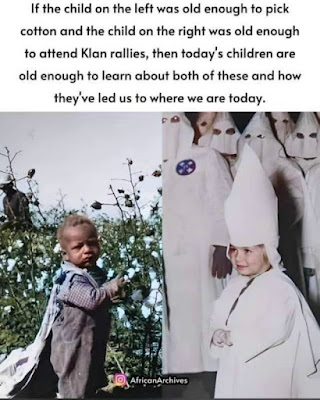
[Image description: Photo of a Black toddler or preschooler in tattered overalls in a field next to a photo of a white toddler or preschooler in a KKK robe in front of a group of adults in KKK robes. Text reads "If the child on the left was old enough to pick cotton and the child on the right was old enough to attend Klan rallies, then today's children are old enough to learn about both of these and how they've led us to where we are today." The instagram account AfricanArchives is credited.] 


The reason that a number of white autistic youth are using slurs with no idea of their impact is because of white privilege, not because they are autistic. And sure, non-autistic white youth may be quicker to intuitively pick up on the meaning and impact of slurs than autistic white youth. But the overall dynamic is still due to white privilege, not that they are autistic. Black children experience racism, thus have to talk about it, much earlier than white children are typically taught about it. 

Black or brown autistic children (with sufficient verbal or spelled language) are no different in this regard. Their families are talking about racism essentially from the time they are born. They know the impact of slurs, because their families are talking about themselves or people in their communities being on the receiving end of these. Black children of all neurotypes are given The Talk starting at an early age, in which they are taught the importance of things such as always getting a receipt and not touching things in stores. Particularly given the rates at which Black and Latine autistic people are undiagnosed, parents aren't holding off on discussing these things with autistic children -- they often don't officially know they have autistic children! In my experience, Black and brown parents who notice that their children struggle with impulse control or language (with a diagnosis or not) are particularly focused on working with their children on being cautious about what they say to whom and how they say it -- because they have to, for safety reasons. 

Similarly, parents of white children who notice they may have differences in how they pick up on and use social information need to be particularly focused on educating their children from an early age as to the meaning and impact of slurs, along with other anti-racism skills such as recognizing microaggressions and responding to these. All parents of white children should be teaching their children to be anti-racist from birth, and autistic or otherwise neurodivergent children may not intuitively pick up on all of this teaching and may need to have the meanings of slurs spelled out. Rote rules around slurs are actually easier to teach than a lot of universal social skills*:

  • these words are violent and hurt people
  • white people may never use them
  • any white person using them is committing a harmful act
  • they might occur in media, and the choice to include them is a separate discussion
  • if you are reading from a text or quoting something and are white, you need to use the censored forms of them
This is probably one of the easiest social skills among those we teach, honestly. There isn't a lot of nuance. If a parent has neglected to teach their white child about slurs, there should be some reflection here. It isn't because it's a hard topic to teach in an education sense; there is clearly something going on where the parent hasn't fully accepted that it is their role as parents of white children to actively teach their children how not to perpetuate racism. 

Finally, low expectations are a form of ableism. We really don't want to perpetuate "they don't know any better because they're autistic," especially around a dynamic where this is objectively not the case. Autistic folks typically have a strong sense of social justice. If they are raised in a way that includes all different perspectives and teaches them about the existence of different types of oppression, they are typically amazing allies for marginalized groups to which they do not belong.


*Universal social skills are the skills that all people of all neurotypes need to learn (consent, boundaries, self-advocacy, negotiation, etc.), which is distinguished from the flawed idea of teaching autistic people "social skills" that really mean to engage in masking or changing their behavior to appear neurotypical with no real functional benefit.